
Vibro-Impact Modeling, Design of Experiments, and Model Validation
Purpose
Vibro-impact systems are sensitive to modeling assumptions, and different model types can produce very different predictions.
This project unified model development, design of experiments, and model comparison to determine which approaches are reliable for engineering use.
Approach
I combined three complementary workstreams:
- Model development: analytical and numerical formulations for impact behavior
- Design of experiments: test matrix definition for stiffness, gap, and excitation variations
- Model comparison: direct cross-checks between analytical, numerical, and measured responses
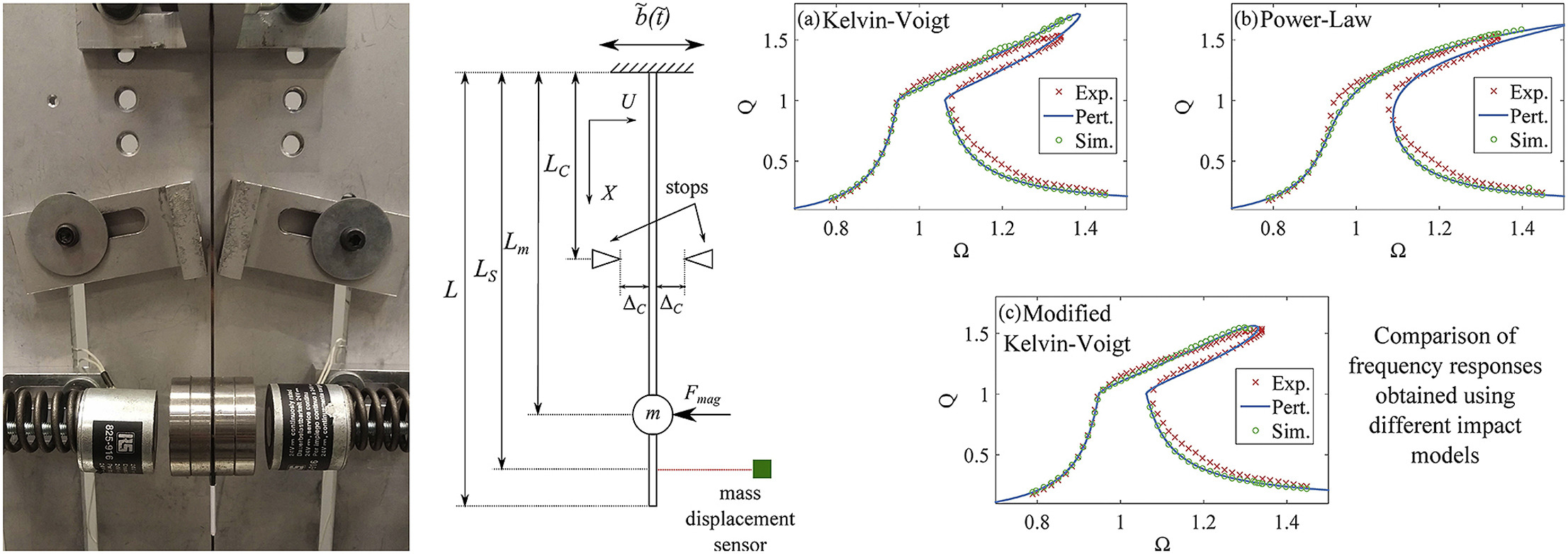
Key Results
- Identified where simplified impact models are acceptable and where they are not
- Quantified mismatch patterns between simulation and experiments across operating regions
- Built a reproducible evaluation structure for selecting fit-for-purpose models
Engineering Value
- Supports faster model selection during early engineering studies
- Reduces decision risk by exposing model limits before deployment
- Improves confidence in simulation-backed recommendations
Implementation
- Instrumented and tuned an experimental rig for controlled impact scenarios
- Ran parameterized simulations for multiple impact model variants
- Compared results using consistent metrics in time and frequency domains
- Refined model assumptions based on observed discrepancies
Tools
MATLAB · Maple (analytical methods) · dSPACE/ControlDesk · Experimental DAQ and instrumentation